Dify: The Visual Builder for People Who Don't Want to Write Agent Code
A node-based LLMOps platform with 140k stars and one honest question to answer.
The clean test for any visual agent builder is whether the team using it can survive the day the senior engineer leaves. Most can’t, and that has nothing to do with the tool. It’s that the visual flow on the screen is the only place the system exists. There’s no repo to clone, no diff to review, no test to fail. The team owns the artifact the way a marketing department owns a Canva file.
Dify is the open-source visual builder that takes that problem more seriously than its competitors. The langgenius repo crossed 142,000 stars this month, version 1.14.2 shipped on May 19, and the project pitches itself now as a “production-ready platform for agentic workflow development” rather than the chatbot builder it started as. The drag-and-drop canvas is still there. So is the prompt IDE, the RAG pipeline, the agent runtime, the tool registry, and the LLMOps tracing layer. It runs self-hosted on Docker in about ten minutes. It is a real piece of software, built by people who have shipped real software, and the recent release notes read like a team that knows what production failure looks like: tenant-scoped credential isolation, workflow execution reliability fixes, memory fetches outside Flask context, base64 file lookup sessions closed correctly. That is not vibes-driven development.
The honest question Dify has to answer in 2026 is not whether it works. It works. The question is who it’s for, and whether the people it’s for know what they’re trading away.
The visual builder pitch is always the same: lower the floor so non-engineers can ship. The Dify canvas lets a product manager wire an LLM node to a knowledge retrieval node to a conditional branch to an HTTP call to a response. The HITL workflows landed properly in 1.14, so you can park a node for human review and resume the trace afterwards. The tool registry has hundreds of pre-built integrations. The same flow can be exposed as a chatbot, an API endpoint, or a workflow that another system calls. None of this requires writing agent code in Python, TypeScript, or anything else. For a four-person team that needs a customer-support assistant on top of their docs by Friday, the value is obvious.
The problem is the second project. The flow that started as a Friday afternoon chatbot becomes the system that handles refund eligibility, then the system that decides whether a clinical claim gets routed for review, then the system that talks to the billing API. Each step makes sense locally. The composite is a piece of production software whose entire definition lives in a database row and whose history lives in the platform’s audit log. Version it by exporting the DSL file. Review changes by diffing exported JSON in a PR description that nobody can read. Test it by clicking through the flow on staging and hoping. This is the part of the visual-builder lifecycle that vendors don’t market and that operators see every time.
This is the same tension the npm-packaged-skills approach was designed to escape. When the agent’s behavior lives in a versioned package with a tagged release, the changes get code review, the tests run in CI, and the rollback is a git revert. When the behavior lives in a Dify flow, the rollback is “restore from yesterday’s database backup and lose every conversation in between.” Both models can ship software. Only one of them treats the agent like software.
That doesn’t make Dify wrong. It makes it a category, and the category has a job to do. The job is letting people who don’t write code build useful AI applications without a developer in the loop for every change. That is a real job, it is worth doing, and Dify does it as well as anything I’ve seen in the open-source space. The mistake is using it for the wrong tier of system. A customer-facing internal tool that summarizes weekly sales data is the right tier. A workflow that touches PHI, makes refund decisions, or sits in front of a regulated process is the wrong tier, no matter how clean the visual flow looks.
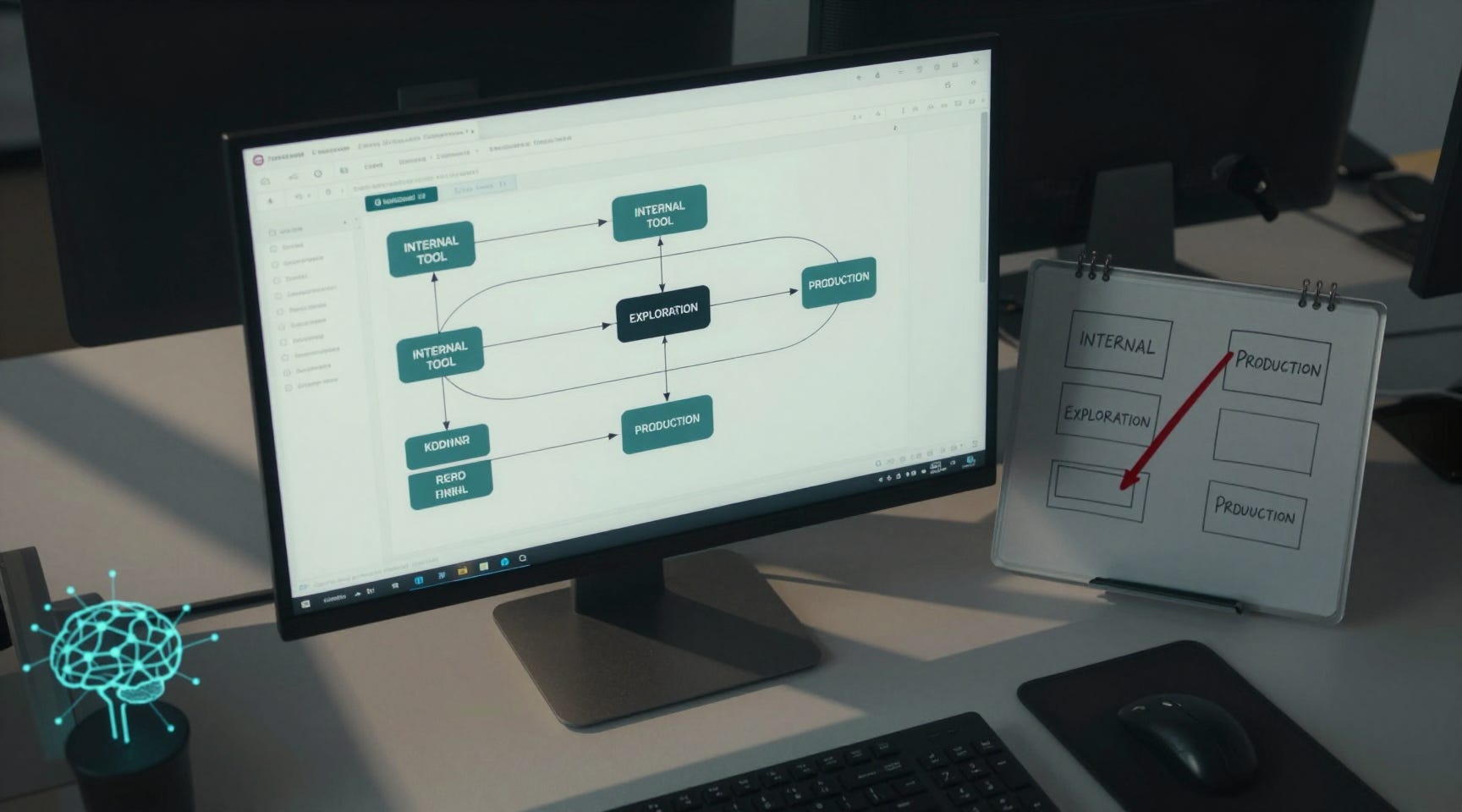
The case I would actually make for Dify in an engineering organization is narrower than the marketing suggests, and stronger because of it. Use it as the front door for prompt and flow exploration before anything gets promoted to a code repo. The product team can sketch a workflow on the canvas, run real traces against real data, prove the idea is worth shipping, and hand the engineering team a working spec with the prompts already battle-tested. That export becomes a starting point for a real implementation in code, not the implementation itself. Visual builder as design surface, code repo as production artifact. Most teams using Dify have the relationship inverted, which is why their second project breaks.
The other honest use is the internal-tools tier. Operations, HR, customer success, finance. Each of those teams has a constant queue of “can we get an AI that does X for our department.” Standing up a development sprint for each request is the wrong economics. A Dify instance behind SSO with department-level tenants is the right economics. The flows live for six months, serve a known internal user base, and don’t sit on the critical path. When one of them outgrows the canvas, you know because it has, and you migrate that one. The platform is doing what visual builders are good at: enabling the work that wasn’t going to get engineering attention anyway.
The cost story matters and is rarely told straight. Self-hosted Dify on a modest VM is essentially free for the platform layer, with the inference cost going to whatever model provider you’re calling through. The hosted version has paid tiers that scale with usage. The hidden cost is the operational one. The platform brings its own database, vector store, redis, sandbox executor for Python tool calls, and plugin daemon. Those are five additional things on the runbook for an SRE team that thought they were adopting one tool. The recent releases have been visibly tightening this. The 1.14.x line has been a steady drumbeat of deployment and runtime fixes, which is what a project does when it knows real ops teams are now running it in real environments. That is healthy. It is also a signal that the operational surface area is wider than the marketing implies.
The release cadence is the strongest signal of all. A project shipping 1.13.2, 1.13.3, 1.14.0, 1.14.1, and 1.14.2 over the past two months is a project with users in production complaining about specific bugs and a maintainer team that resolves them. Compare that to the AI-tool graveyard of repos that hit 30,000 stars in 2024 and haven’t tagged a release since the Series A closed. Dify is in the rarer category of open-source AI infrastructure that is still being maintained like a product.
The verdict for 2026 is simple. Dify is the visual builder I would actually deploy if I had a team that needed one, and the visual builder I would actively keep off the critical path of anything regulated. The product is honest. The category has known limits. Pretending those limits aren’t there is how the visual builder ends up owning a workflow that should have been a code repo six months ago. Use it for what it is, hand the rest to a real codebase, and the platform earns the stars.
If this was useful, forward it to one engineer who needs less noise in their feed.