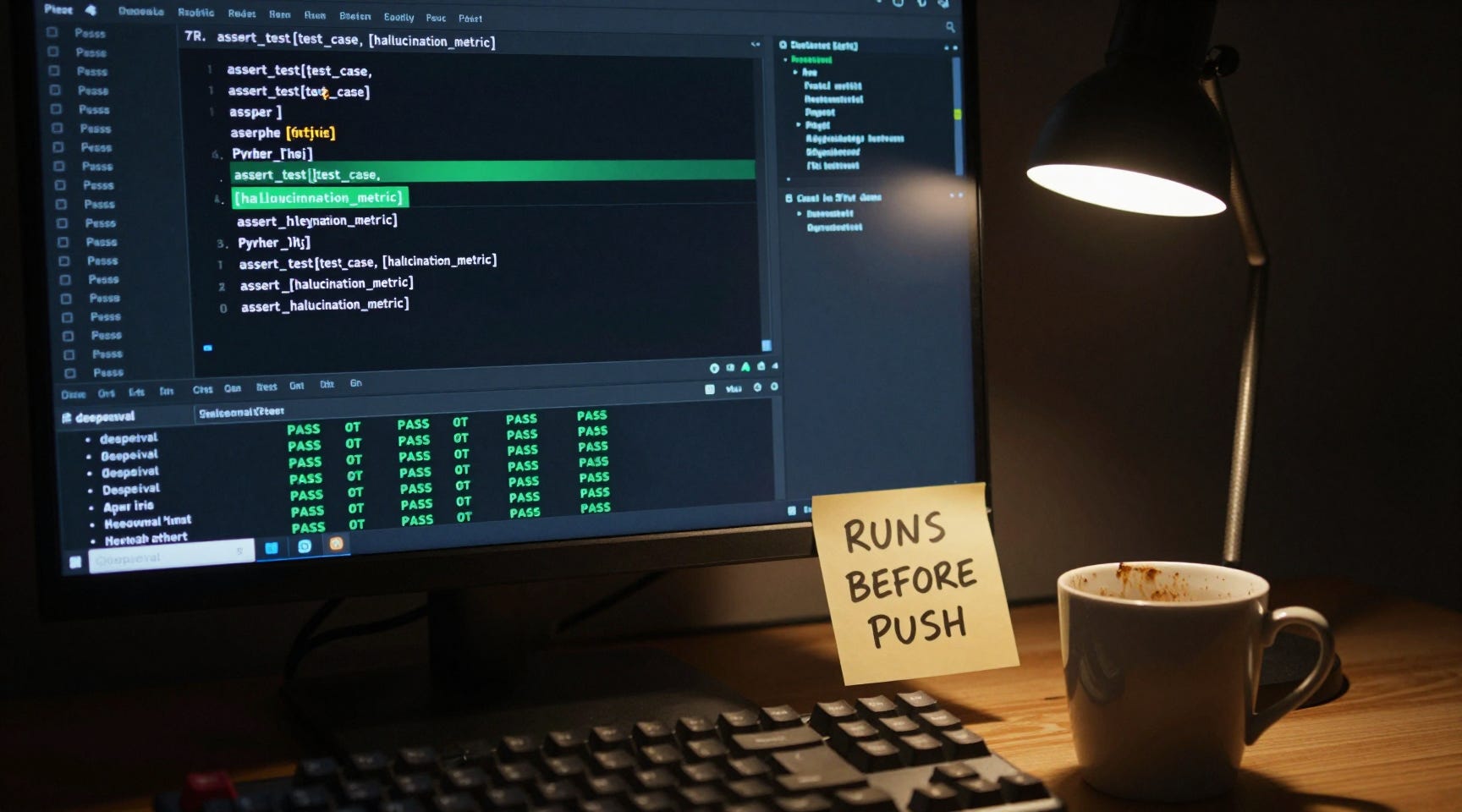
DeepEval
Pytest for LLM Outputs
The eval framework that looks like your test suite. No dashboard required.
Most eval tools ship a platform. DeepEval ships a test runner. The difference sounds cosmetic until you are the person trying to get LLM evaluation into CI without adding a new SaaS subscription, a new login, and a new place where your test results live that is not the place your test results already live. DeepEval is an assert_test() call that drops into your existing pytest suite and reports its results the same way your unit tests report theirs. It does not ask you to adopt a platform. It asks you to write a test.
The API is flat and obvious. Import assert_test. Define a metric. Pass both to assert_test(test_case, [metric]). If the metric score crosses a threshold, the test passes. If it does not, the test fails with a trace that tells you why. This is not a metaphor. This is the actual API. A test for hallucination in a RAG pipeline takes fewer than ten lines of Python and runs inside the same pytest invocation that validates your authentication middleware. The learning curve is the ten seconds it takes to understand that this is only another test framework that happens to call an LLM under the hood instead of a database.
The metric catalog is where DeepEval earns its place in the comparison matrix. It ships forty-plus built-in metrics. G-Eval uses chain-of-thought prompting to score outputs against custom criteria. The hallucination metric compares claims in the model’s output against the provided context and flags fabrications. The RAGAS suite (faithfulness, answer relevancy, context precision, context recall) comes bundled, which means you can run the standard RAG evaluation triad without importing a separate library. Bias metrics, toxicity detection, and summarization coverage round out the safety side. Each metric has a threshold parameter, and assert_test passes or fails accordingly. The framework’s design assumption is that you want the same red/green signal you get from the rest of your test suite, not a dashboard you have to remember to check.
The synthetic-data generation pipeline is the feature that separates DeepEval from frameworks that assume you already have a labeled eval set. Synthesizer takes a knowledge base or a list of documents and generates question-answer pairs, multi-turn conversations, or RAG scenarios backed by the source material. The output is a list of Golden objects: reference answers paired with the context that produced them, ready to feed directly into assert_test. This means you can bootstrap an eval suite from a pile of markdown documentation in a single Python script, run it nightly, and catch regressions before your users do. The quality of the synthetic data depends on the underlying model, and DeepEval lets you specify which model generates it. Swap in Claude Opus 4.8 for the expensive one-time synthesis run and use a smaller model for the nightly regression check.
The red-teaming module shipped in 4.0 and it is the most engineering-forward take on adversarial testing I have seen in an open-source eval framework. RedTeamer takes a target system (a model endpoint, a RAG pipeline, an agent) and runs it through a configurable attack surface: prompt injection, jailbreak attempts, bias probing, PII extraction. Each attack type is a pluggable module. You configure which ones to run, set a concurrency limit, and point it at your system. The output is a set of vulnerabilities with reproduction steps. This is not a compliance checkbox. It is a tool for finding out whether your agent will hand over its system prompt when someone asks nicely enough.
The conversation simulator is the feature that makes DeepEval genuinely useful for agent evaluation. ConversationSimulator takes a simulation_graph (a decision graph controlling how user turns are generated) and runs multi-turn conversations against your agent or RAG system, scoring each turn against configured metrics. The 4.0.3 release added granular control over turn generation logic, which means you can define branching conversation paths where the simulated user responds to the model’s output in specific ways depending on what the model said. This is the closest thing to an automated adversarial conversation partner I have seen in an eval library, and it drops into the same assert_test call that runs your hallucination checks.
The maintenance story matters for eval frameworks because stale eval tooling produces false confidence. DeepEval’s release cadence is aggressive. v4.0.5 landed May 28 with day-zero support for Claude Opus 4.8. v4.0.6 shipped June 10 on PyPI with model support updates. The 4.0 release in mid-May introduced the coding-agent eval harness, a one-line integration API, and a terminal UI for trace inspection. The release before that, 3.9.9 in December, added full agentic eval support with task completion metrics, tool-call scoring, and multi-turn synthetic data generation. This is not a framework that ships a major version and goes quiet for a year. The commit history shows multiple releases per month going back two years. The maintainers ship model presets within 24 hours of a frontier model launch. If you are building eval infrastructure that needs to keep pace with model releases, that cadence is not optional.
The integration surface is the other dimension where DeepEval makes a practical argument. It has native integrations with LangChain, LlamaIndex, and the major LLM providers. It emits OpenTelemetry spans, which means your eval traces feed into the same observability stack that monitors your production services. It has a pytest plugin so deepeval test run and pytest are the same command. The [inspect] extra installs a terminal UI for browsing traces interactively, but the core path (write test, run test, see pass/fail) requires no UI at all. The framework’s design assumes you want CI integration more than you want a dashboard.
The thing to watch is the platform side. Confident AI, the company behind DeepEval, runs Confident AI Cloud, a hosted platform that adds a dashboard, dataset management, experiment tracking, and collaboration features on top of the open-source framework. The platform is where the monetization lives. The open-source framework is genuinely open: Apache 2.0, fully functional, no feature gating behind a license tier. But the long-term health of any open-source project with a hosted sibling depends on how carefully the line between them is maintained. So far the line is clean. The framework does not phone home unless you configure an API key. The metrics run locally. The results stay on your machine. The platform is additive, not a requirement. If that changes, the value proposition changes with it.
The comparison to Inspect AI, which I covered yesterday, is instructive. Inspect is built for regulatory-grade evaluation with sandboxed execution, dataset versioning, and agent bridging. DeepEval is built for the CI pipeline. One is a testing laboratory. The other is a test suite. The distinction matters because most teams need both, and they need them for different reasons. Inspect is what you use when you need to prove to a regulator that your model does not do something dangerous. DeepEval is what you use when you need to know, before you merge, that your RAG pipeline still produces faithful answers. The frameworks are not competitors. They are complementary. Inspect handles the formal evaluation surface. DeepEval handles the continuous one.
The pragmatic test for any eval framework is whether it makes it easier to write evals than to skip them. Most teams skip evals because the tooling friction is higher than the perceived risk of shipping untested LLM behavior. DeepEval reduces the friction to one import and one function call. The risk calculation flips when the cost of adding an eval is lower than the cost of a regression making it to production. That is the same argument that drove unit-test adoption two decades ago, and it is the argument that will drive LLM-eval adoption over the next two. DeepEval is not trying to be the platform that owns your eval workflow. It is trying to be the assert statement that makes you write evals at all. That is the right bet.
If this was useful, forward it to one engineer who needs less noise in their feed.