

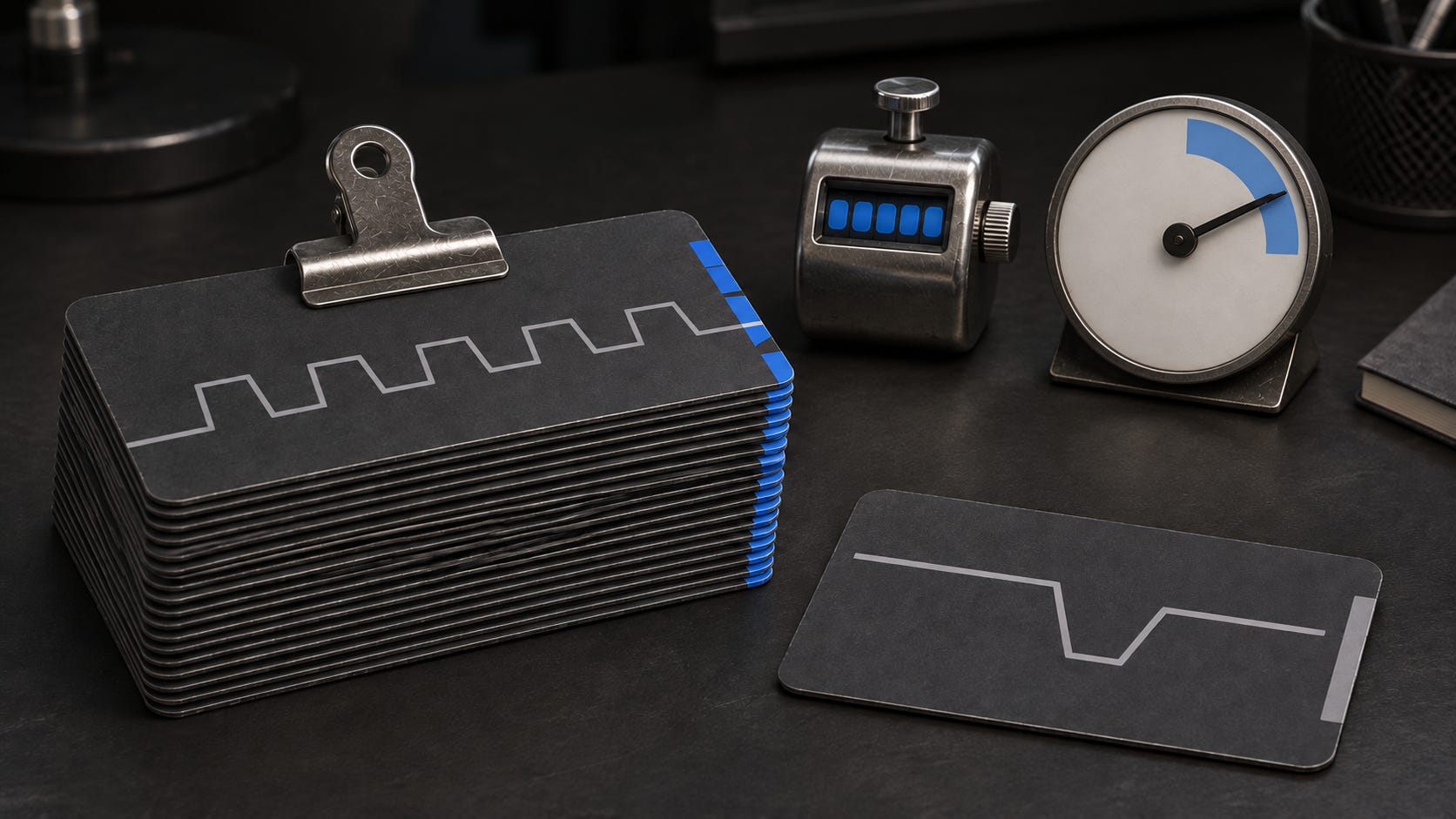
Twenty duplicate timeouts can become one reviewable group only when the count, time boundary and rule that reopens on a changed failure remain visible.
Alert deduplication is a compression rule applied to interruptions. A good rule reduces repeated pages while preserving the evidence that twenty events occurred. A bad rule makes the queue look calm by treating every symptom from one service as the same problem. The design question is not how many alerts can be hidden. It is which differences must force a new group.
Consider a fictional catalog service during a twenty-minute exercise. Twenty synthetic dependency_timeout alerts arrive from the catalog read path between 02:00:12 and 02:08:44 UTC. Each names the same upstream inventory service, operation and severity. A data_integrity_mismatch alert arrives from the catalog service at 02:06:10. One more inventory timeout arrives at 02:19:07, after a ten-minute quiet period. These are fixture events, not measured operational volume.
The intended result is four facts, not one tidy incident count. The first twenty timeouts form one review group. The integrity failure remains separate even though it comes from the same service. The late timeout starts a new group because the first episode expired. Every source event remains available, with its own timestamp and identifier.
This requires structured fields before it requires AI. The stable OpenTelemetry log data model distinguishes the resource that produced a record, its timestamp, severity, event name and occurrence-specific attributes. Those fields provide a vocabulary for a grouping worksheet. They do not decide the policy. An operator still has to define which resource attributes identify the service and which event attributes represent a meaningful failure signature.
Keep identity separate from presentation. Prometheus Alertmanager’s Alerts API documentation says labels are used to deduplicate identical alert instances, while annotations carry supporting information such as summaries and runbook links. A field that must separate one failure from another cannot live only in a mutable description. If failure_signature changes the grouping decision, it belongs in the structured identity used by the rule.
The proposed worksheet uses a group key made from service, failure class and a normalized signature. The timeout fixture uses catalog-api | dependency_timeout | read:inventory-service. Severity is a reopen condition rather than a phrase buried in the message. The group remains open while a matching event arrives within ten minutes of the previous occurrence. Ten minutes is a chosen exercise value, not a universal threshold.
Discussion Topic:
Which field would you trust least in an alert grouping key: service, failure class, or signature?
Walk the twenty timeouts through the rule. The first event opens group G-01 at 02:00:12. Each later event matches the same service, class and signature before the quiet window expires, so the worksheet increments the occurrence count and advances the last-seen time. At 02:08:44, the group shows count 20, first seen 02:00:12 and last seen 02:08:44. It also retains the twenty source identifiers rather than replacing them with a summary sentence.
Now apply the escape rule to the integrity alert. Its service is still catalog-api, but its failure class is data_integrity_mismatch, its signature names a product-version conflict and its severity is critical. It opens G-02 immediately. A rule based only on service would collide with G-01 and suppress the most important change in the fixture. A rule based only on severity would be nearly as weak because unrelated failures can share a severity.
The collision test makes that weakness visible before a grouping policy reaches an on-call queue. Add a timeout from the same catalog service and time window, but set its signature to write:pricing-service. The failure class still says timeout. The changed operation and dependency produce G-03, not another occurrence in G-01. If the worksheet cannot explain that split from its recorded fields, the signature is too opaque to review.
The expiry test challenges the other boundary. The inventory timeout at 02:19:07 matches the original key, but more than ten minutes have passed since 02:08:44. It opens G-04 with count 1. Reusing G-01 forever would erase the distinction between one continuing episode and a recurring failure after a quiet interval. Starting a new group for every event would erase the benefit of deduplication.
Prometheus describes Alertmanager grouping as collecting similar alerts into one notification while retaining which instances were affected. Its routing configuration exposes grouping labels and separate timing controls for the first grouped notification, later changes and repeats. Those mechanisms show why key design and time design are different decisions. A precise key can still page too slowly, while a fast interval can still merge unrelated failures.
Counts and time bounds belong in the group record because the compact notification is not the event history. Preserve the first and last occurrence, current count, source identifiers, highest observed severity and the reason the group reopened. A count that resets without an episode boundary makes volume difficult to interpret. A summary that drops the raw references makes a mistaken merge difficult to reverse.
There is a reasonable objection to normalized signatures. Real error messages carry dynamic identifiers, changing paths and vendor wording. Hashing the entire message creates a new group for every variable value. Stripping every variable can collapse different causes. Define the signature from reviewed fields such as operation, dependency and stable error code, then version that extraction rule. Unknown or malformed signatures should remain visible for review instead of falling into a default bucket that silently absorbs them.
AI can help with the worksheet without owning the policy. It can compare sample events, propose candidate fields, replay collision and expiry fixtures, and flag groups whose members disagree on severity or signature. It should not invent a fingerprint from prose and treat the result as authoritative. The operator chooses the allowed fields, quiet window, escalation conditions and retention requirements.
A mistaken group also needs an escape path after the rule runs. Let the operator split a group, record why the key failed and replay the affected fixtures against a revised policy. Keep the old group identity in the audit record so a cleaner screen does not erase the original decision. A grouping system that cannot explain or reverse a merge turns noise reduction into evidence loss.
This worksheet does not establish a production threshold, prove that twenty pages would have fired, or diagnose the catalog service. It tests one proposed rule against invented events. The evidence supports a narrower decision: duplicate timeouts can share an interruption only when the record preserves their volume and timing, while a changed signature, severity or expired window creates a new reviewable state.
The useful measure of deduplication is not the smallest notification count. It is fewer repeated interruptions without fewer distinguishable failures. One group should make twenty copies easier to review. The next event still needs a way to say that something new has happened.
If this was useful, forward it to one engineer who needs less noise in their feed.